Understanding what is NetSuite is crucial for enterprises planning digital transformation. As Oracle’s leading cloud ERP, NetSuite has become the backbone of operations for more than 40,000 organizations worldwide. From financials and supply chain to CRM and ecommerce, NetSuite unifies critical processes into one system. For enterprises in the US, UK, and UAE, it enables efficiency, compliance, and global growth. In this guide, we’ll explore NetSuite’s applications, benefits, integrations, and how businesses use it to scale.
What Is NetSuite?
At its core, NetSuite is a cloud-based enterprise resource planning (ERP) system. Delivered as Software as a Service (SaaS), it offers a unified platform to manage accounting, operations, human resources, and customer facing activities.
Unlike legacy systems, NetSuite doesn’t require heavy infrastructure or on premise maintenance. It runs entirely in the cloud, offering:
- Anytime, anywhere access via browser.
- A single source of truth with centralized data.
- Seamless updates from Oracle twice a year.
With these capabilities, NetSuite empowers enterprises to reduce IT overhead while gaining agility and real-time visibility.
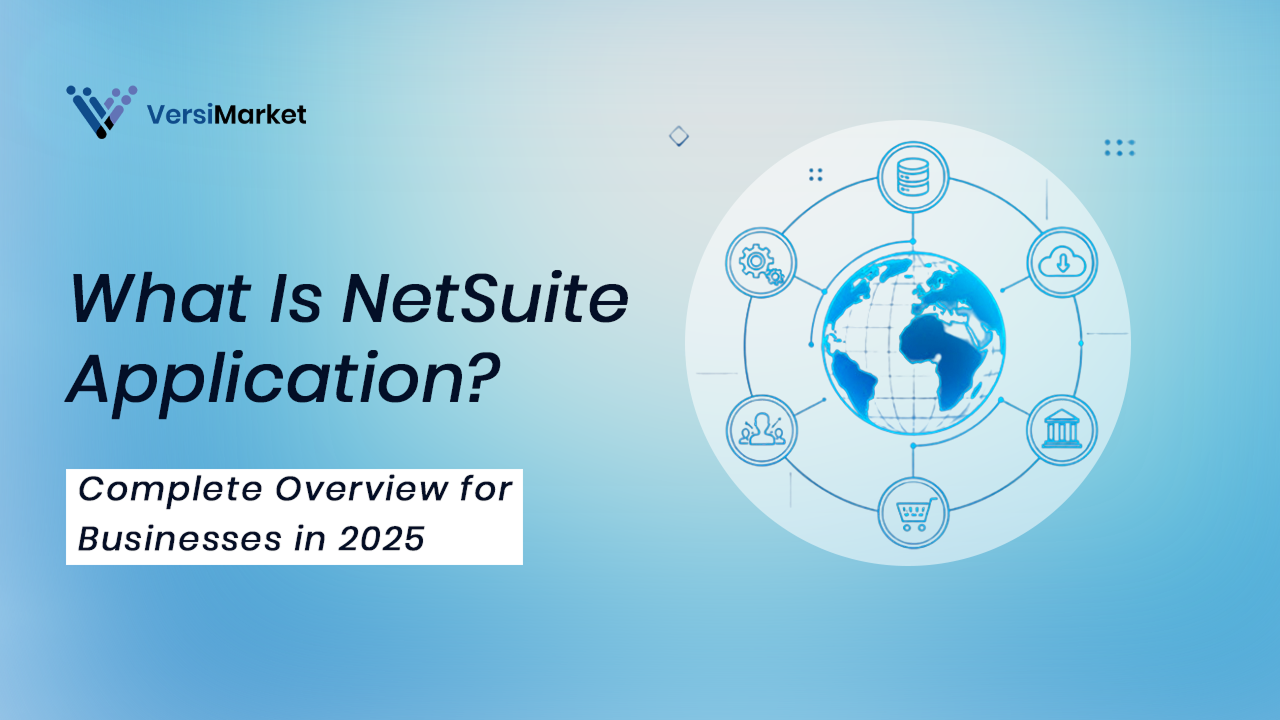
What Is NetSuite Application?
The what is NetSuite application question is best answered by looking at how it replaces fragmented tools with one subscription based suite.
Applications of NetSuite include:
- Financial Management: General ledger, AR/AP, fixed assets, revenue recognition.
- Operations: Procurement, inventory, warehouse, manufacturing.
- CRM: Lead-to-cash processes, customer service, sales tracking.
- Human Resources: Payroll, workforce management, employee self service.
- Ecommerce (Suite Commerce): Online storefronts integrated with ERP.
These applications represent the application of NetSuite across industries. Whether it’s a SaaS business managing revenue recognition or a manufacturer streamlining supply chain, NetSuite adapts to diverse enterprise needs.
What Is NetSuite Used For?
So, what is NetSuite used for in practice? Enterprises adopt it to:
- Automate repetitive tasks across finance, HR, and operations.
- Gain real time visibility into performance.
- Manage multi entity and multicurrency operations.
- Comply with industry regulations (e.g., GAAP, IFRS).
- Replace siloed legacy tools with a unified system.
For CFOs, it shortens close cycles; for operations leaders, it improves inventory accuracy; and for sales teams, it ensures faster quoting and billing.
Architecture and Access – How NetSuite Works in Practice
NetSuite’s architecture is based on three pillars:
- Multi-Tenant SaaS: All customers share the same codebase, with data securely isolated.
- Unified Database: One source of truth across departments.
- Role Based Access: Personalized dashboards for executives, managers, and staff.
This structure makes NetSuite scalable, secure, and reliable for enterprises of all sizes.
Core Modules and Features
NetSuite’s strength lies in its modular design. Key components include:
- ERP and Financials: General ledger, AR/AP, cash management, consolidation.
- Operations: Procurement, inventory, manufacturing, WMS.
- CRM: Sales force automation, service, and partner management.
- Ecommerce: Suite Commerce for B2B and B2C integration.
- HR and PSA: Payroll, workforce management, project tracking.
For enterprises that require unique features, NetSuite development provides customization, while NetSuite integration ensures connection with third-party systems like CRM, logistics, or BI tools.
End-to-End Workflows That Define NetSuite Business
NetSuite isn’t just software it enables end-to-end NetSuite business processes:
- Order-to-Cash (O2C): From quoting in CRM to invoicing and cash collection.
- Procure-to-Pay (P2P): From requisitions and vendor management to payment and reconciliation.
- Record-to-Report (R2R): From journal entries to consolidated financial reporting.
These workflows eliminate silos, reduce manual effort, and improve cross-departmental collaboration.
Roles, Security, and NetSuite Administration
The role of NetSuite administration is critical for ERP governance. Administrators ensure:
- Proper role-based access controls (RBAC).
- Compliance with segregation of duties (SoD).
- Regular audits and monitoring.
- Coordination of updates and customizations.
Without strong administration, enterprises risk data breaches, compliance gaps, and user confusion.
Suite-Cloud, Customization, and Development
For businesses with unique needs, NetSuite development through Suite-Cloud provides flexibility.
- Suite-Builder: Point-and-click customization.
- Suite-Flow: Workflow automation.
- Suite-Script: JavaScript-based scripting for complex logic.
- Suite-Talk APIs: Integration with external systems.
Through NetSuite integration and development, enterprises can extend NetSuite to cover advanced scenarios, from e-commerce portals to industry-specific compliance reporting.
Benefits of NetSuite for Enterprises
The benefits of NetSuite include:
- Unified Data: One system for all business functions.
- RealTime Reporting Instant dashboards for executives.
- Global Reach: Multi-entity, multicurrency, multilanguage support.
- Scalability: Add subsidiaries, modules, or users as needed.
- Lower IT Overhead Cloud delivery eliminates costly infrastructure.
These benefits make NetSuite attractive to fast-growing companies as well as established global enterprises.
NetSuite Advantages and Disadvantages
Like all platforms, NetSuite has strengths and tradeoffs.
Advantages:
- Cloud native, globally scalable.
- Frequent updates from Oracle.
- Strong partner ecosystem.
- End-to-end process coverage.
Disadvantages:
- Requires skilled admins and consultants.
- Customization can increase costs.
- Licensing can be expensive for small businesses.
Enterprises should weigh these NetSuite advantages and disadvantages when deciding on adoption.
NetSuite Implementation and Deployment
A successful rollout depends on a structured approach. NetSuite implementation typically follows the Suite Success methodology:
- Discovery and planning.
- Configuration and customization.
- Data migration.
- Training and UAT.
- Go-live and hyper-care.
By leveraging certified consultants and ERP experts, enterprises reduce risk and accelerate time to value.
Conclusion
At its core, answering what is NetSuite means understanding its role as more than software. It is a complete business platform a cloud-native ERP that enables global operations, compliance, and automation. From financials to ecommerce, NetSuite integrates all business functions into one unified system.
For enterprises, its applications extend far beyond accounting it’s a growth engine that provides visibility, scalability, and long-term value.
Join VersiMarket Today

At VersiMarket, we connect enterprises with certified NetSuite consultants and developers who deliver results.
- For Businesses: Hire vetted professionals for NetSuite implementation, integration, and development.
- For Consultants: Join VersiMarket to connect with enterprises seeking expertise.
Join VersiMarket today and ensure your NetSuite investment drives measurable success.