If you’re asking is NetSuite ERP or EPM is the most accurate answer, the most accurate answer is that NetSuite is a cloud ERP, and Oracle also offers NetSuite EPM as a complementary suite for planning, budgeting, forecasting, consolidation, and reporting. Enterprises don’t choose one or the other; they combine both to align operational truth with forward-looking finance. This guide clarifies roles, differences, and where each adds value, so your finance and operations leaders stay in lockstep
Is NetSuite ERP or EPM?
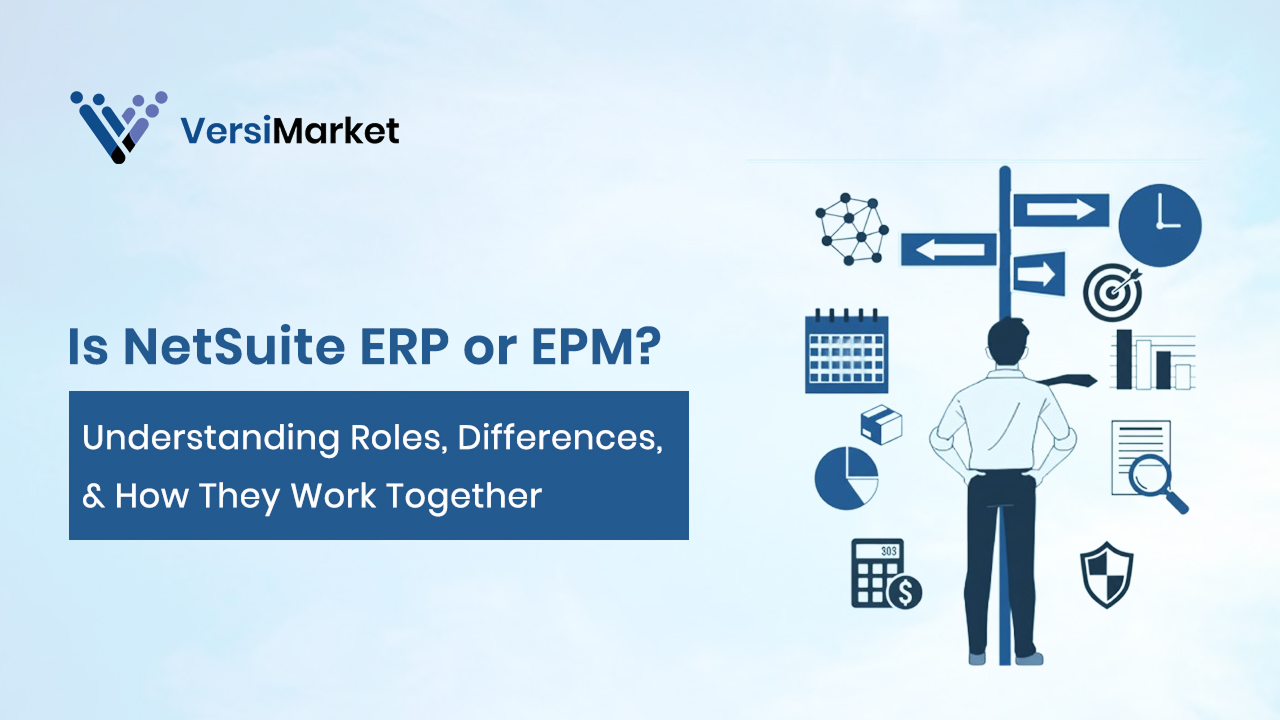
Is NetSuite ERP or EPM? NetSuite is primarily an ERP, your system of record for transactions across finance, operations, inventory, CRM, and commerce. NetSuite EPM (by Oracle) is a separate but connected suite focused on planning, budgeting, forecasting, account reconciliation, close, consolidation, profitability analysis, and narrative/tax reporting. They’re complementary, not substitutes: ERP runs the day-to-day engine; EPM drives strategic finance and decision-making.
What Is ERP? And where NetSuite ERP fits
Enterprise Resource Planning centralizes operational transactions-general ledger, AP/AR, order management, procurement, inventory, manufacturing, CRM, and ecommerce- into one system with auditability and real-time visibility. NetSuite ERP provides this operational backbone on a single data model with role-based dashboards so teams across finance, operations, and sales work from the same source of truth. Those are the core capabilities you’re tapping when you adopt NetSuite erp solutions for daily execution and compliance.
When leaders ask is NetSuite ERP or EPM, they’re usually trying to pinpoint where budgeting and forecasting belong. That’s where EPM enters.
What Is NetSuite EPM?
What is NetSuite EPM? It’s Oracle’s cloud EPM suite, planning and budgeting, account reconciliation, financial close and consolidation, profitability and cost management, plus narrative and corporate tax reporting, integrated to consume ERP actuals and publish management insights back to the business. You may see it referenced as NetSuite EPM or EPM NetSuite when discussed alongside the ERP core; either way, its users are CFOs, controllers, and FP&A teams who need driver-based models, rolling forecasts, scenario planning, and standardized close cycles.
Put simply, is NetSuite ERP or EPM? It’s both-operational ERP and strategic oracle NetSuite EPM working together.
ERP vs. EPM: Scope, Users, and Focus
Think of ERP as the transaction engine and EPM as the planning brain:
Scope & Users
- ERP: Spans finance ops, inventory/SCM, manufacturing, CRM/commerce. Used daily by staff across departments.
- EPM: Strategic finance suite for FP&A, controllers, CFOs, and executives.
Primary Focus
- ERP: Transaction accuracy, automation, compliance, operational reporting.
- EPM: Budgets, forecasts, scenarios, management reporting, and consolidation.
This complementarity is why the question is NetSuite ERP or EPM requires a dual answer-you need both to run and steer the business.
How NetSuite ERP and NetSuite EPM Work Together
Operational actuals originate in ERP; EPM ingests those actuals for planning, forecasting, and consolidated reporting; then EPM outputs guidance-budgets, targets, and management narratives-that align operating teams. The NetSuite EPM connector streamlines that flow, cutting manual reconciliations and reducing error-prone handoffs between systems so finance can close and plan faster with confidence.
When leaders debate is NetSuite ERP or EPM, this bidirectional alignment is the reason the right answer is “both.”
Feature Comparison: ERP vs. EPM
Below is a condensed view of how NetSuite ERP or EPM in practice (ERP = system of record; EPM = system of insight):
- General Ledger / AP / AR: ERP processes transactions and maintains books; EPM consumes consolidated figures to build budgets/forecasts and management reports.
- Revenue Recognition: ERP applies accounting rules automatically; EPM models the impact on forecasts and scenarios.
- Inventory/SCM & Manufacturing: ERP tracks stock, fulfillment, and WIP; EPM uses cost/volume drivers for capacity and margin planning.
- CRM/Commerce: ERP manages orders/customers; EPM uses revenue drivers in planning models.
- Close & Consolidation / Reconciliation: ERP posts entries and supports intercompany workflows; EPM automates account reconciliation, close, consolidation, and management reporting across entities.
Every line in that comparison reinforces why is NetSuite ERP or EPM is really about the handoff between daily truth (ERP) and financial foresight (EPM)
Implementation and Timelines: What Changes with ERP vs EPM
- ERP implementations affect multiple departments-finance, operations, supply chain, sales-plus master data, integrations, and training. Timelines often span months to over a year depending on scope and global complexity.
- EPM implementations are narrower and finance-led, focusing on planning cycles, reconciliations, and consolidation. They’re typically faster to deploy because they rely on structured ERP actuals and finance processes.
Understanding this difference is essential when deciding how to phase your roadmap-and another angle on is NetSuite ERP or EPM for your immediate priorities.
Reporting Differences: Operational vs. Management
- ERP reporting surfaces transactional/operational metrics: AR aging, order statuses, WIP, inventory turns, and role-based dashboards that drive execution.
- EPM reporting publishes consolidated financials, budget vs actuals, variance analysis, driver-based forecasts, scenario comparisons, and narrative/tax compliance reports.
So, is NetSuite ERP or EPM for reporting? ERP answers “what happened,” while EPM answers “what it means and what we’ll do next.”
Buyer Guidance and Fit Signals – When to Start with Which
- Prioritize ERP when systems are disconnected, master data is inconsistent, processes are manual, or multi-entity operations need standardization and auditability.
- Accelerate EPM when budgeting lives in spreadsheets, close cycles drag, consolidations are manual, or leadership needs robust scenarios and rolling forecasts.
This buy-side lens keeps the NetSuite ERP or EPM conversation grounded in business outcomes rather than product labels.
Example End-to-End Use Cases (ERP and EPM in the wild)
- Monthly Close & Consolidation: ERP captures transactions and reconciliations; EPM automates account reconciliation, multi-entity consolidation, and management reporting to shrink time-to-close.
- Annual Planning & Rolling Forecasts: ERP provides actuals and operational drivers; EPM builds models, scenarios, and rolling plans, feeding approved targets back to operating leaders and dashboards.
These show why the answer to is NetSuite ERP or EPM is nearly always “both-at different points of the cycle.”
Organizational Roles and Responsibilities
- ERP ownership sits with finance operations, operations leaders, and IT/admins (permissions, integrations, governance).
- EPM ownership sits with the CFO, controller, and FP&A, who govern planning cycles, reconciliations, consolidation, and performance reporting.
Clear ownership prevents process gaps and clarifies how to operationalize is NetSuite ERP or EPM inside your org chart.
Common Pitfalls and Fixes
- Pitfall: Using transactional ERP reports as a substitute for forward-looking planning.
- Fix: Use EPM for driver-based plans, scenarios, and management narratives.
- Pitfall: Implementing EPM before stabilizing ERP master data (COA, entities, dimensions).
- Fix: Standardize in ERP first so EPM models have clean inputs.
- Pitfall: Over-customizing ERP to emulate planning workflows.
- Fix: Keep ERP lean for transactions; leverage EPM for forecasting/consolidation.
Again, the best answer to is NetSuite ERP or EPM is to align each to its strengths.
KPIs to Track Value Realization
- ERP outcomes: DSO/DPO, month-end close cycle time, order-to-cash lead time, inventory turns, SLA adherence.
- EPM outcomes: Forecast accuracy, planning-cycle time reduction, time-to-close, reconciliation accuracy, and analytics adoption by executives.
These KPI sets help you quantify the “system of record” vs “system of insight” split that underlies is NetSuite ERP or EPM.
Is NetSuite ERP or EPM?
Is NetSuite ERP or EPM? NetSuite is ERP; NetSuite EPM is the complementary planning/close/consolidation suite from Oracle. You can implement them separately, but the biggest value comes from connecting them via the NetSuite EPM connector so ERP actuals drive EPM plans and EPM guidance aligns operational execution.
Conclusion
Answering whether NetSuite ERP or EPM is the right way ensures you don’t shortchange either side of performance management. NetSuite ERP delivers operational discipline, accurate transactions, automation, compliance, and real-time dashboards across finance, inventory, manufacturing, CRM, and commerce. NetSuite EPM extends that foundation with budgeting, forecasting, consolidation, account reconciliation, profitability, and narrative/tax reporting. Together, they create a modern system of record and a modern system of insight-so you run efficiently today and plan effectively for tomorrow.
Join VersiMarket Today

Enterprises across the US, UK, and UAE use VersiMarket to hire vetted experts for both NetSuite erp and NetSuite epm programs-strategy, implementation, integration, close/consolidation, and rolling forecasts.
- For Businesses: Post requirements and match with certified ERP/EPM specialists, including architects who know the NetSuite epm connector inside out.
- For Consultants: Join our marketplace to deliver NetSuite erp solutions and oracle NetSuite EPM value for leading enterprises.
Join VersiMarket today to align ERP execution with EPM insight-and turn plans into performance.