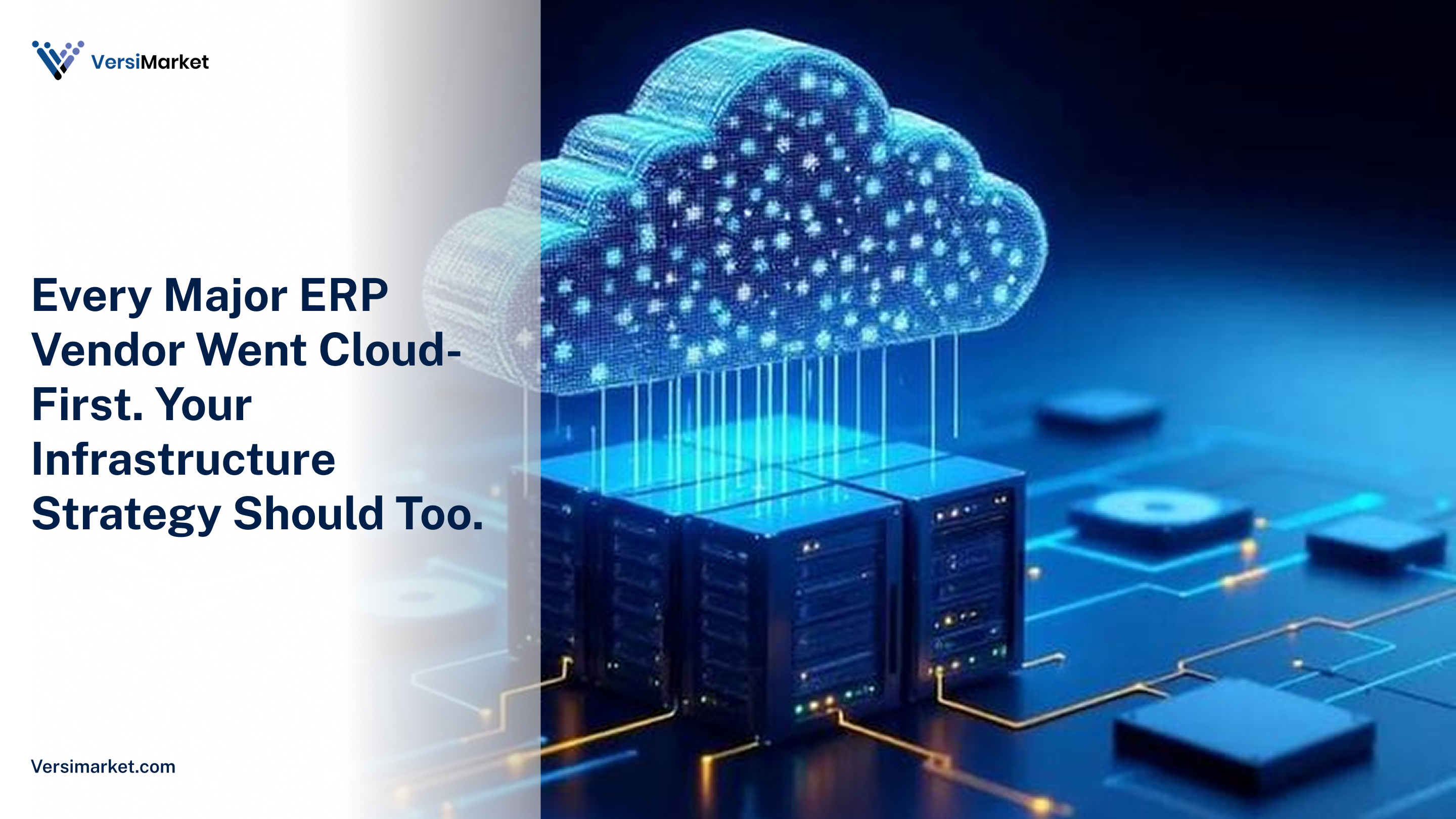
79% of new ERP implementations are going cloud-first. If your business is still running on-premise in 2026, you are not saving money – you are deferring a much larger bill. Here is what the data actually says.
Table of Contents
ToggleIntroduction
There is a version of the on-premise ERP argument that made sense in 2015.
It does not make sense in 2026.
The structural shift to cloud ERP is no longer a trend being debated in technology circles. It is the operational reality for the majority of businesses implementing or upgrading ERP systems right now. Seventy nine percent of new ERP implementations are going cloud-first. The remaining twenty one percent are making a choice they will be paying for in maintenance costs, upgrade cycles, and infrastructure overhead for years to come.
This article is for the businesses still in those twenty one percent, and for the ones evaluating which path to take.
The Numbers That Have Already Settled the Argument
The case for cloud ERP is no longer built on projections. It is built on what is already happening across the market.
Seventy nine percent of new ERP implementations in 2026 are cloud-first. The Asia-Pacific region which is currently the fastest growing ERP market globally and is projected at sixteen percent compound annual growth through 2035, and that growth is almost entirely cloud. Seventy four percent of organisations have now moved to cloud-based disaster recovery specifically for ransomware protection with a risk profile that on-premise infrastructure handles significantly worse than cloud environments.
These are not forecasts. They are the current state of the market.
The businesses still running on-premise are not bucking a trend. They are extending a liability.
What On-Premise Is Actually Costing You
The on-premise argument is almost always framed as a cost saving. The reality is that it is a cost deferral and the deferred bill compounds with time.
On-premise ERP requires hardware investment that depreciates and eventually needs replacing. It requires an IT team spending meaningful time on infrastructure maintenance rather than on work that builds competitive advantage. It requires upgrade projects which are the kind that historically run eighteen months, go over budget, and disrupt operations during execution. And it carries a security and disaster recovery exposure that cloud architecture handles structurally rather than reactively.
None of those costs disappear when a business chooses on-premise. They get pushed forward, and they grow.
The server room that feels like a cost centre today becomes a strategic liability the moment a competitor running cloud ERP spins up a new subsidiary without ordering hardware, closes a faster month-end, or recovers from a ransomware attempt in hours rather than weeks.
The security exposure is worth dwelling on specifically. On-premise infrastructure places the full burden of patch management, vulnerability monitoring, and incident response on the internal IT team. Cloud ERP vendors handle this at the platform level — deploying security updates automatically, maintaining compliance certifications continuously, and operating disaster recovery infrastructure that most mid-market businesses could not afford to replicate independently.
The seventy four percent of organisations that have moved to cloud-based disaster recovery specifically for ransomware protection are not making a technology preference decision. They are making a risk management decision and the data on ransomware frequency and recovery cost makes that decision increasingly straightforward.
On-premise infrastructure does not just cost more to run. It costs significantly more when something goes wrong. And in 2026, the question is not whether something will go wrong. It is how prepared the organisation is when it does.
What Cloud ERP Actually Changes Operationally
The benefits of cloud ERP are not primarily technological. They are operational and the distinction matters for how businesses should be evaluating the decision.
Automatic updates eliminate the upgrade project entirely. Patches, compliance updates, and new features deploy without an eighteen-month implementation cycle and without the associated cost and disruption. The platform stays current without the business having to make it so.
Scalability becomes structural rather than planned. Adding a new entity, a new market, or a new business unit does not require a hardware conversation. It requires a configuration conversation and that is a significantly faster and cheaper one.
The finance function gains flexibility that on-premise cannot replicate. Real-time financial visibility, remote access, and faster close cycles are not features of a specific cloud ERP product, they are characteristics of cloud architecture applied to financial operations.
And the IT team gets redirected. Infrastructure maintenance is handled at the platform level. The internal team shifts from keeping systems running to building the capabilities that actually differentiate the business.
The compliance dimension is also worth flagging for finance teams specifically. Tax regulations, reporting standards, and financial compliance requirements update continuously across most jurisdictions. On-premise ERP requires manual upgrade cycles to incorporate those changes cycles that take time, cost money, and create windows of non-compliance between the regulatory update and the system update. Cloud ERP handles this automatically. Compliance stays current because the platform stays current. The finance team does not have to manage the gap.
For organisations operating across multiple jurisdictions or planning to, this is not a minor operational detail. It is a structural advantage that compounds as the business grows into new markets.
The Major Platforms Have Already Made Their Position Clear
Every major ERP vendor has moved to cloud-first as their primary development and deployment direction.
NetSuite was built as a cloud-native platform from the ground up. Microsoft Dynamics 365 is cloud-first with on-premise options becoming increasingly marginal in the product roadmap. SAP S/4HANA’s cloud edition is the direction the company is actively pushing its customer base toward which the 2027 ECC deadline exists in part because SAP is accelerating that transition. Salesforce operates entirely in the cloud.
When every major vendor is building toward the same architecture, staying on-premise means building against the direction of the platforms you depend on. That is not a sustainable position.
Where Versimarket Fits into This Transition
The decision to move to cloud ERP is the strategic one. The implementation is where the value is either captured or lost.
Cloud ERP implementations that deliver their projected ROI share a common characteristic where they were configured by specialists who understood both the platform an
d the business requirements it needed to serve. The ones that fall short were implemented generically, without that alignment between platform capability and operational reality.
Versimarket connects businesses with vetted cloud ERP specialists across NetSuite, Salesforce, SAP and Microsoft Dynamics consultants who have implemented these platforms before, understand the decisions that determine project outcomes, and can be engaged directly without the overhead of a traditional consulting firm.
For businesses making the move to cloud ERP in 2026, the implementation decision is as important as the platform decision. Getting the right specialist on the project from day one is what determines whether the transition delivers what it should.
Conclusion
The cloud ERP debate is over.
The businesses still running on-premise in 2026 are not making a considered technology choice. They are deferring an inevitable transition and paying a compounding cost while they wait.
The question is no longer whether to move to cloud ERP.
It is how to implement it in a way that actually delivers the operational advantage the platform is capable of, and who is the right specialist to make that happen.
Make the Cloud ERP Move With the Right Specialist
The platform decision is only half of it. Versimarket connects you directly with vetted cloud ERP specialists across NetSuite, Salesforce, SAP, and Microsoft Dynamics, the people who have run these implementations before and know what actually determines the outcome. No agency overhead. Just the right expert, matched to your project.