Table of Contents
ToggleMuleSoft and Agentic AI: Why Enterprise Integration Is the Foundation of AI Strategy
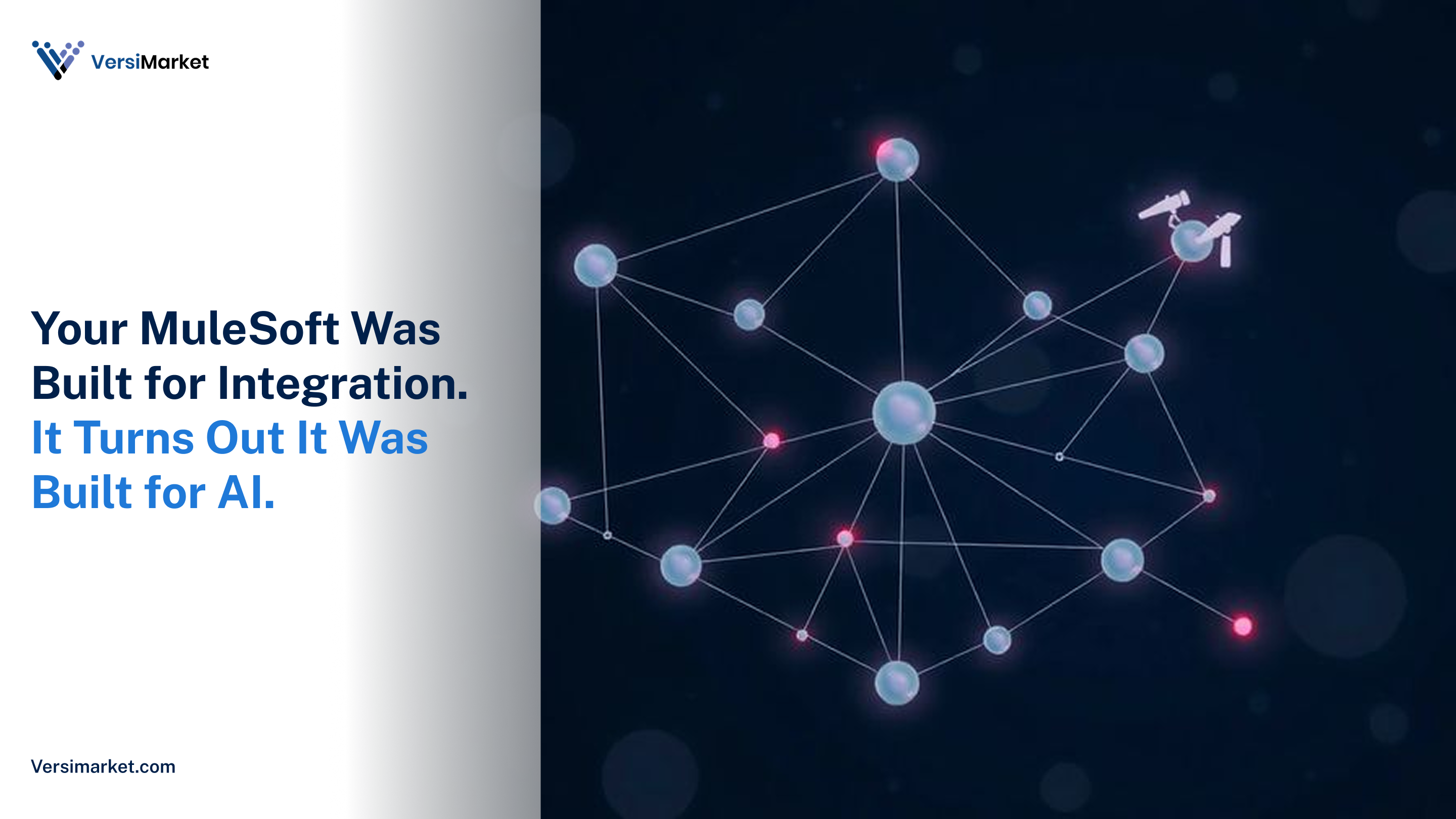
MuleSoft is not legacy infrastructure. In the age of agentic AI, its API-led architecture, MCP connector, and governance framework make it the foundation every enterprise AI strategy depends on. Here is why and what it means for your business.
There is a version of the MuleSoft conversation that has been happening in enterprise technology circles for years, one that frames it as expensive, rigid, or increasingly irrelevant in a world of lightweight SaaS integrations and low-code connectivity tools.
That conversation is about to look very wrong.
Because the architecture that critics questioned are API-led connectivity, composability, modularity, governed reuse which turns out to be exactly what enterprise agentic AI requires to function at scale. The organisations that invested in building that foundation are not sitting on legacy infrastructure. They are sitting on a strategic advantage at the precise moment the market needs it most.
This article is about what that shift means for enterprise architecture, for AI strategy, and for the specialist expertise required to implement it correctly.
From Integration Platform to Intelligence Infrastructure
MuleSoft has never been purely an integration tool. But the clearest articulation of what it actually is has taken time to emerge and agentic AI has finally made it undeniable.
Agentic AI refers to autonomous systems that do not just generate outputs but take actions, reasoning through complex business logic, making decisions, triggering workflows, and operating across enterprise systems without requiring human approval at every step. These agents are increasingly being deployed across CRM, ERP, supply chain, finance, and customer-facing operations.
For those agents to work correctly, they need something the enterprise rarely has in clean, accessible form which are structured, governed, real-time access to the systems and data they need to act on.
This is the integration problem. And it is exactly what MuleSoft was built to solve.
The API-led architecture that MuleSoft pioneered is building reusable, composable layers of connectivity between systems and is now the structural foundation that makes agentic AI operationally viable in enterprise environments. Agents need seamless access to systems, data, and processes. API-led architecture, when implemented correctly, is what provides that access in a way that is governed, secure, and scalable.
MuleSoft is not adjacent to the enterprise AI conversation. It is foundational to it.
What Has Changed and What Has Not
One of the more important observations about MuleSoft in the context of AI is that the core of what makes it valuable has not fundamentally changed. The pillars that have always defined strong enterprise integration which are security and governance, deep observability, robust development tooling, seamless data connectivity, and flexible deployment still remain exactly what agentic AI requires.
What has changed is the layer of intelligence and autonomy being built on top of those pillars.
Several recent MuleSoft capabilities make this concrete.
Anypoint Code Builder and a VS Code-based IDE now extends seamlessly to AI-native development environments like Cursor, Windsurf, and Trae.ai. Developers can generate API specifications, Mule flows, and tests using natural language from inside the tools they already work in. This is not a cosmetic update. It fundamentally changes how quickly integration work gets done and reduces the time between architecture decision and working implementation.
MuleSoft AI Chain provides a framework for designing the full agentic lifecycle by enabling interaction with large language models, vector databases, APIs, and token management within a single governance framework. Organisations are already using this to implement RAG workflows, document search, agentic DevOps, and a growing range of autonomous operational workflows.
And the MCP connector are arguably the most significant development for organisations thinking about AI agent deployment which transforms existing MuleSoft APIs into accessible tools and resources that AI agents can use directly. The composable foundation an organisation already has becomes immediately available to the AI layer being built on top of it.
Critically, none of this compromises the governance framework. Agent-to-agent and MCP governance support ensures that AI innovation inside a MuleSoft environment does not create security gaps, visibility blind spots, or control failures. The autonomy increases. The governance does not decrease.
The API-Led Architecture Debate Resolved by AI
For years, the most common criticism of MuleSoft’s API-led connectivity model was that it introduced complexity with too many layers, too much architecture overhead, too rigid a framework for organisations that just needed to connect two systems.
Agentic AI has effectively resolved that debate.
The composability and modularity that critics called excessive overhead is now the structural property that makes enterprise AI deployment viable. Agents operating across complex enterprise landscapes need to access specific capabilities, specific data sets, and specific processes, in a governed, auditable, repeatable way. That is precisely what well-implemented API-led architecture provides.
Organisations that applied API-led thinking pragmatically start building for reuse and composability rather than just solving the immediate connectivity problem which are now discovering that the foundation they built is organically positioning them to accelerate AI initiatives. The organisations that took shortcuts are discovering that those shortcuts now need to be rebuilt before their AI strategy can move forward.
The architecture was not wrong. The timeline for understanding why it was right was just longer than expected.
What This Means for Organisations Evaluating or Running MuleSoft
The strategic implication is straightforward: MuleSoft is not infrastructure to manage. It is capability to leverage and the gap between organisations that leverage it well and those that merely run it is widening as AI deployment becomes the primary competitive differentiator in enterprise operations.
Three things are worth evaluating for any organisation in this position.
Is your existing MuleSoft implementation built for composability or just for connectivity?
There is a meaningful difference between a MuleSoft environment that connects systems and one that is architecturally composable. The composable environment is the one that enables AI agent deployment. If the current implementation was built for point-to-point connectivity without API-led structure, that is the technical debt that now needs addressing before the AI layer can be built effectively.
Does your team understand the MCP connector and what it enables?
The ability to transform existing APIs into AI-accessible tools is one of the most significant developments in enterprise integration in recent years. Organisations that understand this capability and have the specialist expertise to implement it correctly are the ones that will move from static automation to intelligent orchestration fastest.
Is the governance framework keeping pace with the AI ambition?
Agentic AI operating inside enterprise systems without adequate governance is a security and compliance risk. The governance conversation needs to happen alongside the AI capability conversation not after something goes wrong.
What a Well-Implemented MuleSoft Environment for AI Actually Looks Like
Understanding that MuleSoft is foundational to agentic AI is one thing. Knowing what a correctly implemented environment looks like in practice is another and this is where most organisations discover the gap between their current setup and what AI deployment actually requires.
Three characteristics that define a MuleSoft environment genuinely ready for agentic AI.
The API layer is composable, not just connected.
Point-to-point integrations that were built to solve specific connectivity problems are not the same as a composable API architecture. Agentic AI needs to access specific capabilities and data sets in a governed, repeatable way and that requires APIs that were designed for reuse, not just for the immediate problem they were originally solving. Organisations that built for composability have a head start. Organisations that built for connectivity have technical debt to address before the AI layer can be effectively deployed on top.
Governance structures are configured for autonomous agent activity.
Human users operate within permission frameworks that were designed around human decision-making speeds and patterns. AI agents operate faster, more frequently, and across more touchpoints simultaneously. Governance frameworks that were adequate for human users may not be adequate for autonomous agents operating at scale. Role-based access controls, agent-to-agent governance, and MCP governance configurations need to be reviewed specifically against the AI use cases being deployed and not just inherited from the pre-AI implementation.
Observability is deep enough to monitor what agents are doing.
One of the most underappreciated requirements for agentic AI deployment in a MuleSoft environment is observability. When an autonomous agent triggers an action, something needs to be capturing what happened, why it happened, and whether it happened correctly. MuleSoft’s observability capabilities with transaction tracing, platform insights, and OpenTelemetry support which are what make agentic workflows auditable. Implementations that were not set up with deep observability in mind will need that layer added before AI deployment is responsible at enterprise scale.
Where Versimarket Fits
The expertise required to implement MuleSoft in the context of agentic AI is specific. It requires fluency in MuleSoft’s platform architecture, understanding of API-led design principles, familiarity with the MCP connector and AI Chain framework, and the ability to configure governance structures that support autonomous agent activity without creating risk.
That is not a generalist skill set. It is a specialist one and finding it through traditional consulting channels in a market where demand for this expertise is accelerating is becoming increasingly difficult.
Versimarket connects businesses directly with vetted MuleSoft specialists who have the platform depth and the AI architecture understanding to implement this correctly. Not a firm with overhead and a queue. A specialist matched to your project, engaged on your terms.
The organisations that build the integration intelligence layer now will not be playing catch-up when agentic AI becomes the operational standard across enterprise technology.
Conclusion
MuleSoft is not a platform that peaked before AI arrived.
It is the platform that the enterprise AI era was unknowingly being built toward and the organisations that understand that now have a meaningful head start on the ones still treating it as legacy infrastructure.
The intelligence layer of the modern enterprise needs a foundation. MuleSoft, implemented correctly, is that foundation.
Need a MuleSoft Specialist Who Understands the AI Layer?
Implementing MuleSoft for agentic AI requires more than standard platform expertise. Versimarket connects you directly with vetted MuleSoft specialists who have the API architecture depth and AI implementation understanding to get this right with no agency overhead, no generalist consultants.